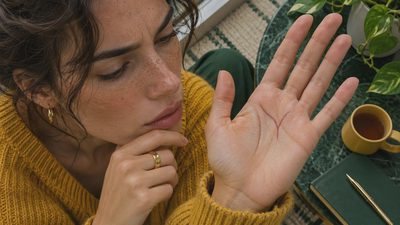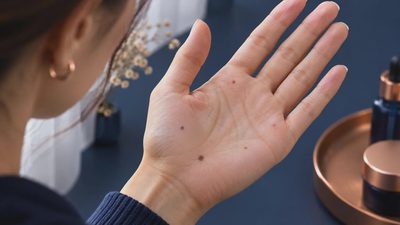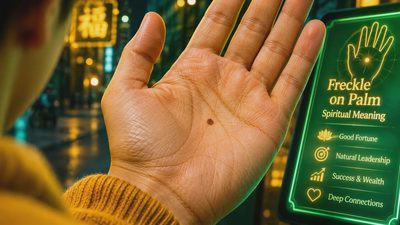
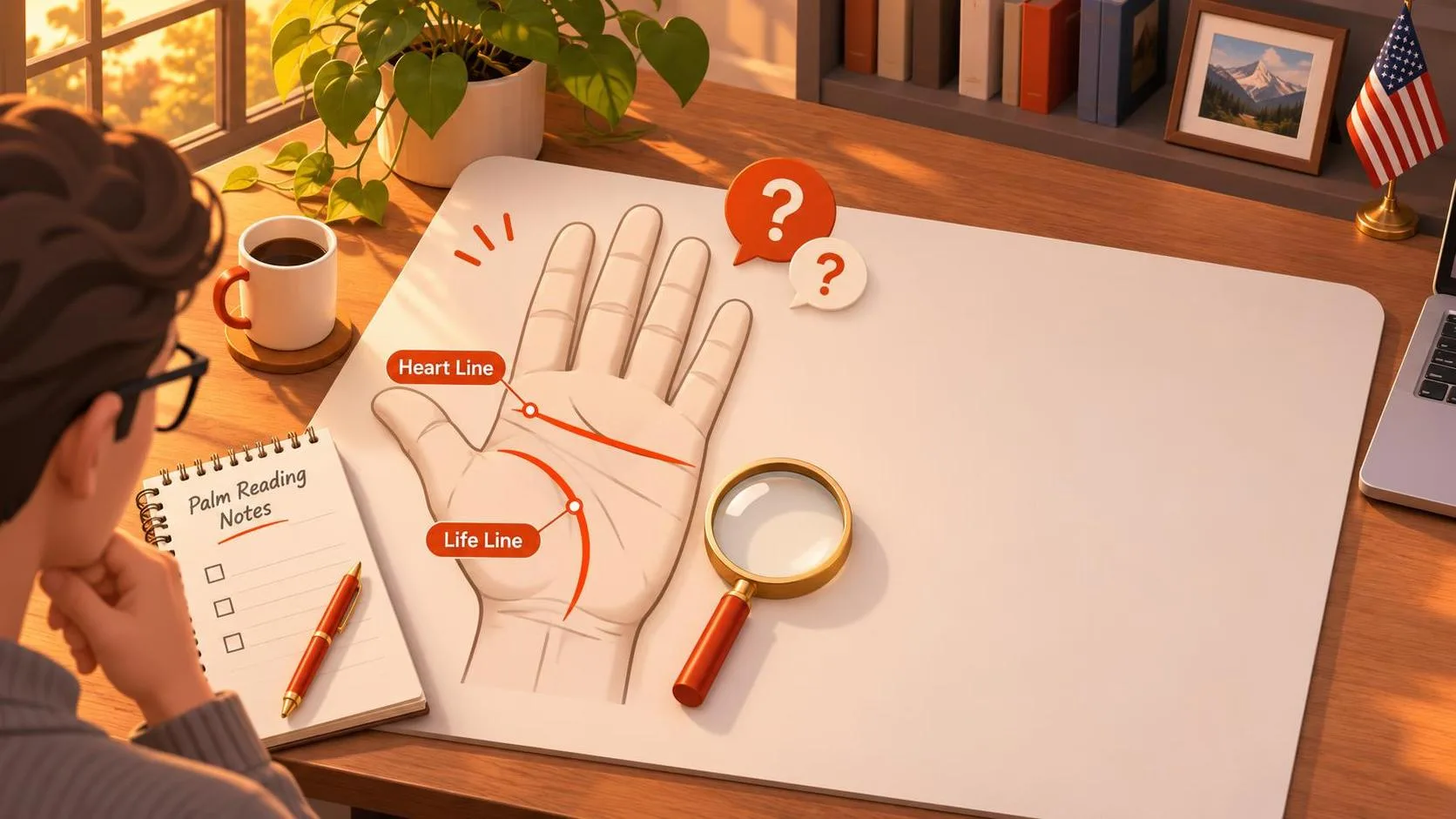
A small cross under a finger, a fork at the end of a line, or a faint island in the middle can be surprisingly absorbing to look at. When people ask about palm marks meaning, they usually want to know whether those shapes say something important about their lives. In palmistry, marks are read as symbolic prompts, not reliable predictions or medical evidence. A cross might invite a conversation about a challenge or a turning point; it does not announce that something bad will happen.
Start with what you can actually see
Before interpreting a mark, describe it without giving it a story. Is it a cross made by two lines? A fork at the end of one line? A small enclosed shape? Note where it sits and whether it is clear or only appears when you bend your hand.
Palm marks meaning varies between palmistry traditions, and readers often disagree. Location matters to many readers, but there is no universal code that turns every shape into the same answer. A mark may also look different as your hand moves or the light changes.
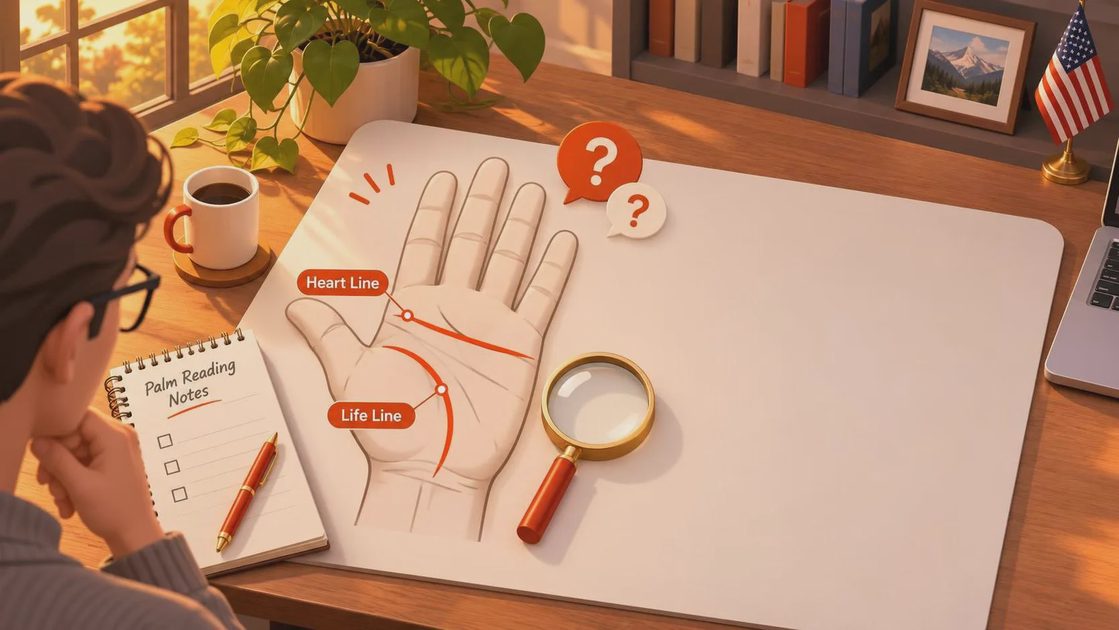
A useful starting point is to locate the three lines commonly discussed in beginner readings. The heart line generally runs across the upper palm beneath the fingers. The head line runs across the middle of the palm, and the life line curves around the base of the thumb. Their names are traditional labels, not measurements of love, intelligence, or lifespan.
If you read both hands, notice differences without treating either one as the definitive version of you. Some traditions associate the dominant hand with how a person acts in the world and the other with inherited tendencies or inner life. Others interpret them differently. Which description, if any, gives you an interesting question to consider?
Common shapes and their traditional associations
The most helpful way to explore palm marks meaning is to treat each interpretation as a possibility. Here are a few shapes you might see and the questions readers commonly attach to them.
A cross is formed where two lines intersect. Some readers associate a distinct cross with a challenge, a significant choice, or an area of heightened attention. A tiny intersection can also be an ordinary crease. Rather than asking what disaster it predicts, ask whether the area of life suggested by its location feels especially active or complicated right now.
A star is usually described as several short lines meeting near one point. Traditional interpretations range from intensity and sudden change to a notable talent, depending on the reader and the location. If the lines do not clearly meet, you do not have to force them into a star. What draws your attention to that area of the palm?
An island looks like a small oval or enclosed loop along a line. Some palmists read it as a period of divided attention, uncertainty, or strain related to that line's theme. For example, an island on the heart line might prompt reflection on emotional complexity, not a declaration that a relationship is doomed. Does that description connect with anything you have actually experienced?
A fork occurs when one line splits into two branches. Readers may associate it with competing directions, flexibility, or an expanding set of choices. A fork on the head line, for instance, might invite a conversation about balancing practical and imaginative thinking. Are you weighing two approaches, or is the shape simply an interesting crease?
A square is a small enclosed shape with roughly four sides. In some traditions it symbolizes protection or containment, especially around another mark. Think of that as an invitation to consider your support systems, not a promise that you are shielded from harm. What helps you feel supported when things get messy?
Does the location change the reading?
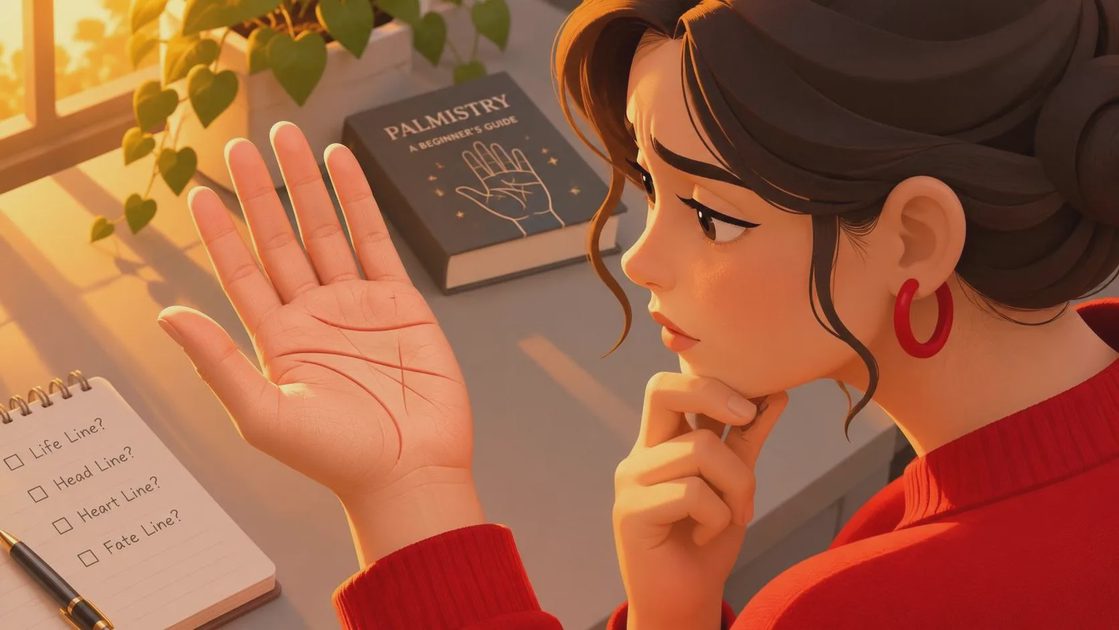
For many readers, yes: palm marks meaning comes from the shape and the area around it together. A cross near the heart line might be discussed in relation to connection or feelings, while a similar cross near the head line might prompt questions about decisions or mental focus. Neither placement proves anything about your personality.
Palmists also look at mounts, the padded areas of the palm. The mount of Venus sits at the base of the thumb and is traditionally linked with affection and vitality. The mount of Jupiter is beneath the index finger and is often linked with ambition or leadership. A mark in either place might lead to a different conversation, but the boundaries between areas are not precise.
Context matters more than a single dramatic symbol. Look at whether the mark is part of a larger line, made by several fine creases, or visible only at a particular angle. If two readers see different shapes, that disagreement can be useful: it reminds everyone that interpretation is not a laboratory result.
What about breaks, short lines, and new marks?
A break in a line is traditionally read by some palmists as a transition or interruption. A short life line is sometimes associated with a particular style of energy in a reading. It does not predict an early death, and neither feature can tell you how long you will live. If a reading leaves you frightened, you are allowed to put it aside.
The phrase palm marks meaning should not be used to explain away a physical change. Palm creases and skin appearance can vary with movement, lighting, and dryness. If you notice a new or changing spot, a persistent rash, pain, or another skin concern, a healthcare professional can assess it. Palmistry is not a substitute for that conversation.
Share a reading, then make it personal
If you want another perspective on palm marks meaning, take a clear photo in even light with your hand relaxed and the whole palm visible. Share only what you are comfortable making public, and crop out identifying details in the background. Point to the feature you mean and say which hand it is. Then invite observations before interpretations: “Do you see a fork here, or two separate lines?”
A symbolic reading can also inspire a thoughtful gift, but start with the person's actual habits and your budget. Someone who enjoys writing might appreciate a small notebook with a note about the choices their forked line brought to mind. For someone who likes quiet evenings, a favorite tea and a handwritten invitation to catch up may say more than a palm-themed object.
The story is the connection, not a claim that the mark guarantees anything. What do you notice in your own hand, and what part of the interpretation fits your real life?