If you want to learn palmistry, start with the hand in front of you rather than a dramatic prediction. Notice the palm’s shape, the length of the fingers, the texture of the skin, and which lines are easy to see. Traditional palmistry treats these details as symbols for reflection, not fixed proof of what will happen. That distinction keeps the practice curious, useful, and kind.
A good beginner reading sounds less like “your future is decided” and more like “here is a pattern readers traditionally associate with this feature; does it resemble how you approach life?” You can read your own hand, compare hands with a partner, or invite a friend to upload a clear photo for discussion. The goal is not to win an argument about fate. It is to notice something, ask a better question, and listen to the answer.
Start with the hand, not the lines
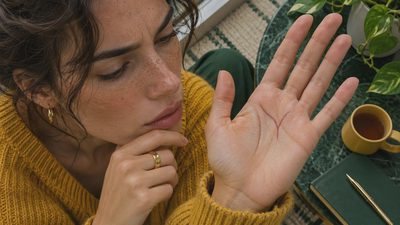
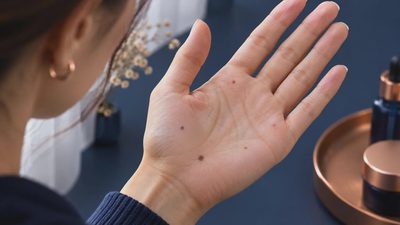
Before you learn palmistry lines, examine the whole hand. Take a photo in natural light with the palm open and the fingers relaxed. Avoid a flash that creates sharp glare, and include the wrist so the lower palm is visible. If you are reading someone else, ask permission before touching their hand or saving an image.
Look at proportions first. Is the palm noticeably longer than the fingers, or do the fingers extend farther than the palm? Are the fingers broad, narrow, straight, or flexible? Is the skin soft, dry, smooth, or marked by work? Traditional systems use these observations to discuss broad tendencies such as practicality, sensitivity, communication, or energy. They are starting points, not personality tests.
Compare both hands as well. Many readers use the less-used hand for inherited tendencies and the dominant hand for habits and choices developed over time. That is a tradition, not a universal rule, so treat it as one possible framework. A person who writes with the right hand might still find that both palms tell a more useful story when viewed together.
The four major lines in plain English
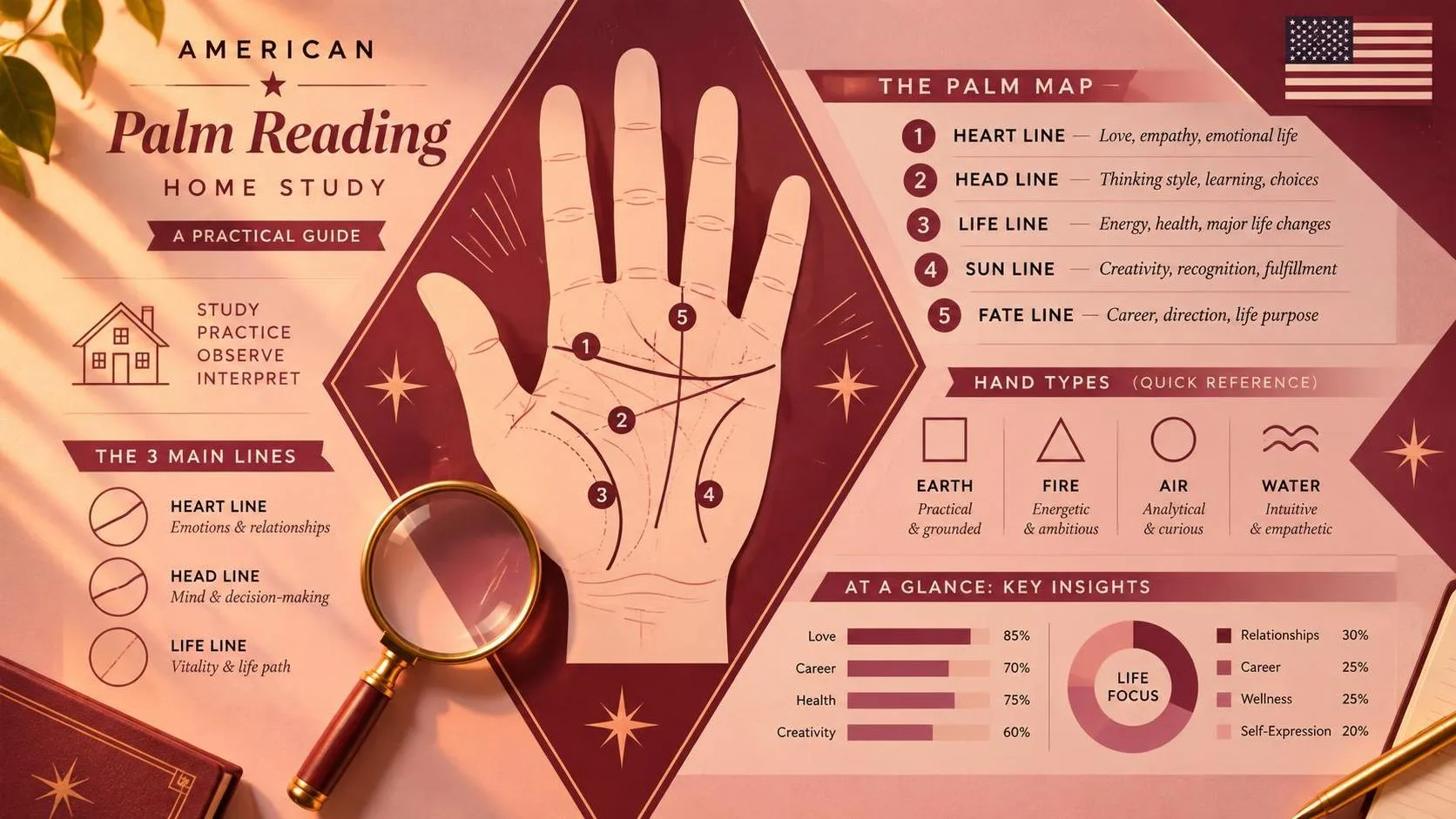
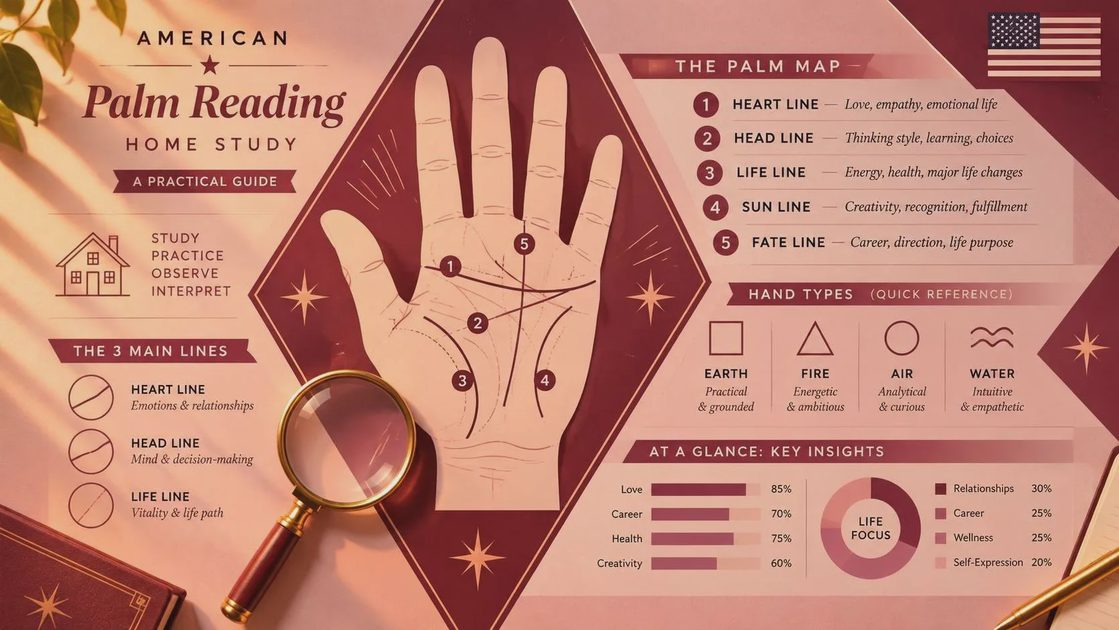
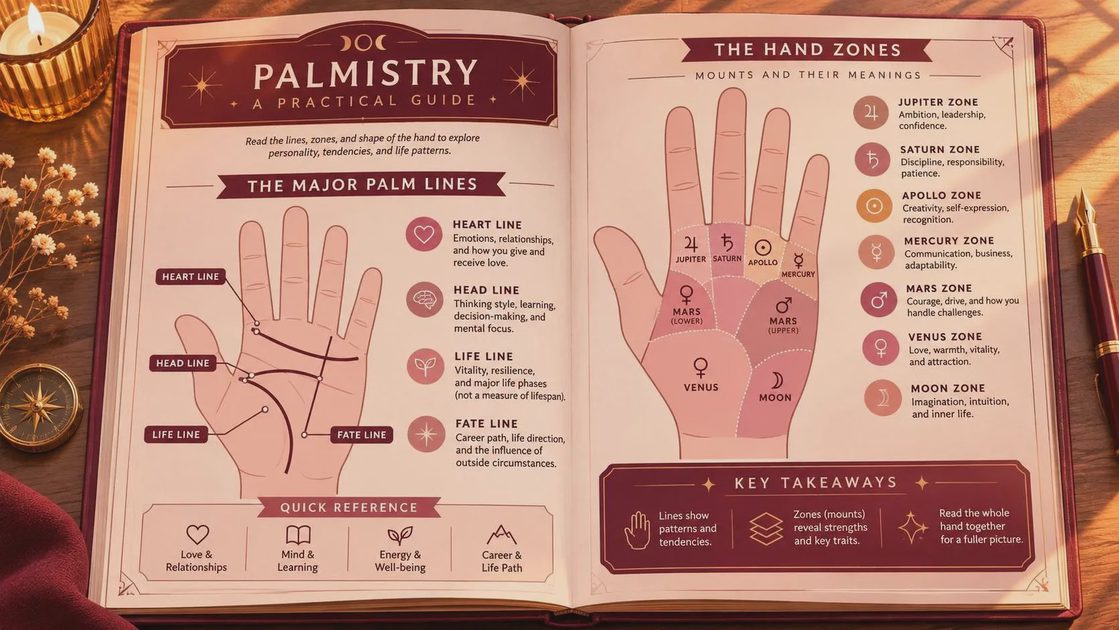
The heart line usually runs across the upper palm below the fingers. Readers traditionally connect it with emotional expression, attachment, and relationship habits. A deep, curved line might be discussed as an open way of showing feeling, while a straighter line may suggest a more private or measured style. Neither shape proves that someone is romantic, distant, loyal, or difficult.
The head line usually crosses the middle of the palm. In traditional readings, it represents thinking style, attention, and the way someone approaches decisions. A relatively straight line is sometimes associated with practical reasoning; a line that slopes toward the lower palm may be read as imaginative or intuitive. Ask what the person actually does with those tendencies. Do they make lists, sketch ideas, debate every option, or change direction when inspiration arrives?
The life line curves around the base of the thumb. This is the line that causes the most unnecessary anxiety. It is not a clock, a health report, or a prediction of death. Readers commonly associate it with vitality, routine, and the way a person engages with daily life, while its length is not a measure of lifespan. A short life line can be perfectly ordinary, and a faint one may simply be harder to photograph.
The fate line, when visible, rises through the center of the palm toward the middle finger. Some traditions connect it with work, direction, and outside responsibilities. Many people have a faint, interrupted, or absent fate line. That does not mean they lack purpose. It can simply make a reading about changing paths, flexible plans, or self-directed choices more interesting.
Read intersections and texture carefully
Once you learn palmistry basics, resist the urge to interpret every tiny crease. Focus on the clearest features first. A line may look broken because the hand is bent, the image is blurry, or several fine lines overlap. Ask for a second photo with the palm flat before building a large interpretation around one mark.
Intersections can add context, but they should not become a maze. For example, a head line that begins close to the life line is traditionally discussed as cautious decision-making or a strong need for preparation. If the lines separate early, some readers describe greater independence. Those are possible lenses, not diagnoses. The person’s real stories matter more than the diagram.
The mounts, or raised areas of the palm, are another traditional feature. The padded area below the thumb is often called the Mount of Venus and is associated with warmth, pleasure, and physical energy. The area beneath the little finger is linked with communication and practical exchange. You do not need to memorize every mount on your first day. Choose one visible feature and compare it with lived experience.
How to learn palmistry without overclaiming
A simple practice routine works better than collecting dramatic meanings. First, make an observation without interpretation: “The heart line is deep and curves upward.” Second, record two traditional interpretations: perhaps expressive affection or strong emotional ideals. Third, ask a grounded question: “Do you usually show feelings quickly, or do you prefer time and trust?” This three-step method separates what you see from what you assume.
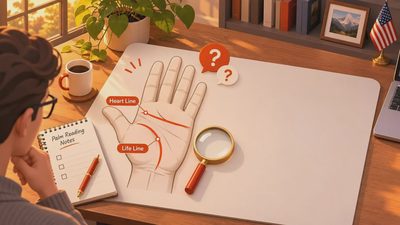
Keep a notebook with the date, a sketch, and the person’s own response. After a few weeks, review which interpretations created useful conversation and which felt generic. This is how you learn palmistry with discernment. You will also notice that hands change in appearance with temperature, hydration, work, age, and lighting. A reading should leave someone more curious about their choices, not worried about an unavoidable outcome.
Avoid claims about illness, death, pregnancy, criminal behavior, or guaranteed wealth. Palmistry can be a reflective pastime, but it is not a medical exam, financial plan, or substitute for professional support. If someone is anxious about a line, bring the conversation back to the ordinary explanation first and remind them that a palm is not a sentence.
Turn a reading into a meaningful gift
The most memorable palm-inspired gift begins with the recipient’s life, not a random symbol. Someone who keeps a journal might enjoy a small leather notebook paired with a handwritten note about the head line and the questions they are exploring. A friend who loves jewelry might prefer a simple engraved bracelet or ring, provided the design matches their everyday style. A parent who values family stories could enjoy a framed palm sketch with a few warm observations from relatives.
Budget does not determine meaning. Under $25, choose a quality notebook, a printed palm illustration, or a small card explaining one line. Around $40 to $80, consider a handmade ceramic dish, a custom line-art print, or a personalized keychain. Above $100, a commissioned illustration or carefully selected jewelry can work when you know the person’s taste. Avoid buying a large mystical object for someone who prefers subtle, practical items.
If you are learning palmistry for a birthday, anniversary, or friendship milestone, include the story behind the gift. Write what you noticed, what the person said, and why the object reminded you of them. The present then becomes a record of attention rather than a claim about destiny.
A beginner’s checklist for your next reading
Start by asking permission and explaining that the reading is for reflection. Photograph both palms in even light. Observe hand shape, finger proportions, texture, and the clearest major lines. Describe the feature before naming its traditional meaning. Offer two plausible interpretations instead of one absolute claim. Invite the person to say what fits their real experience. Keep health, death, and guaranteed predictions out of the conversation. End with a question such as, “Which part feels familiar, and which part does not?”
That process makes it easier to learn palmistry while respecting the person whose hand you are viewing. It also gives disagreements a useful place. If someone sees a line differently, compare photographs, lighting, and traditional sources rather than treating the difference as a personal failure. Palmistry has many schools, and thoughtful readers can acknowledge that history without pretending every claim is proven.
Keep the conversation open
The best readings do not close a person inside a label. They offer a small mirror: a pattern to consider, a memory to revisit, or a question worth asking. You can learn palmistry through books, workshops, community discussions, and patient comparison, but your strongest tool will remain careful observation.
When you share a palm photo online, crop out unrelated personal details and ask before reposting anyone else’s image. Invite people to describe their own experience rather than telling them who they are. Then, if the reading inspires a gift, connect that gift to a real habit, inside joke, or shared moment. What feature did you notice, and what story does the person already tell about themselves?