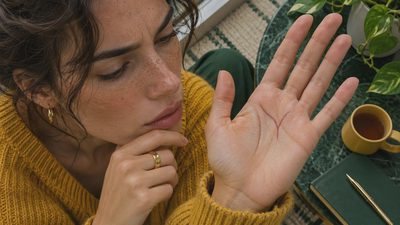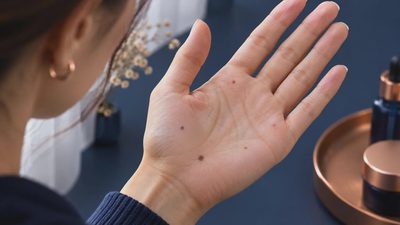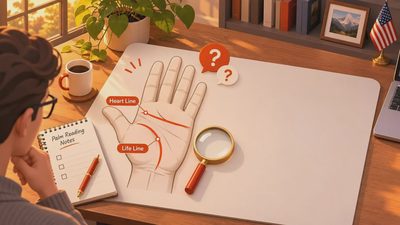
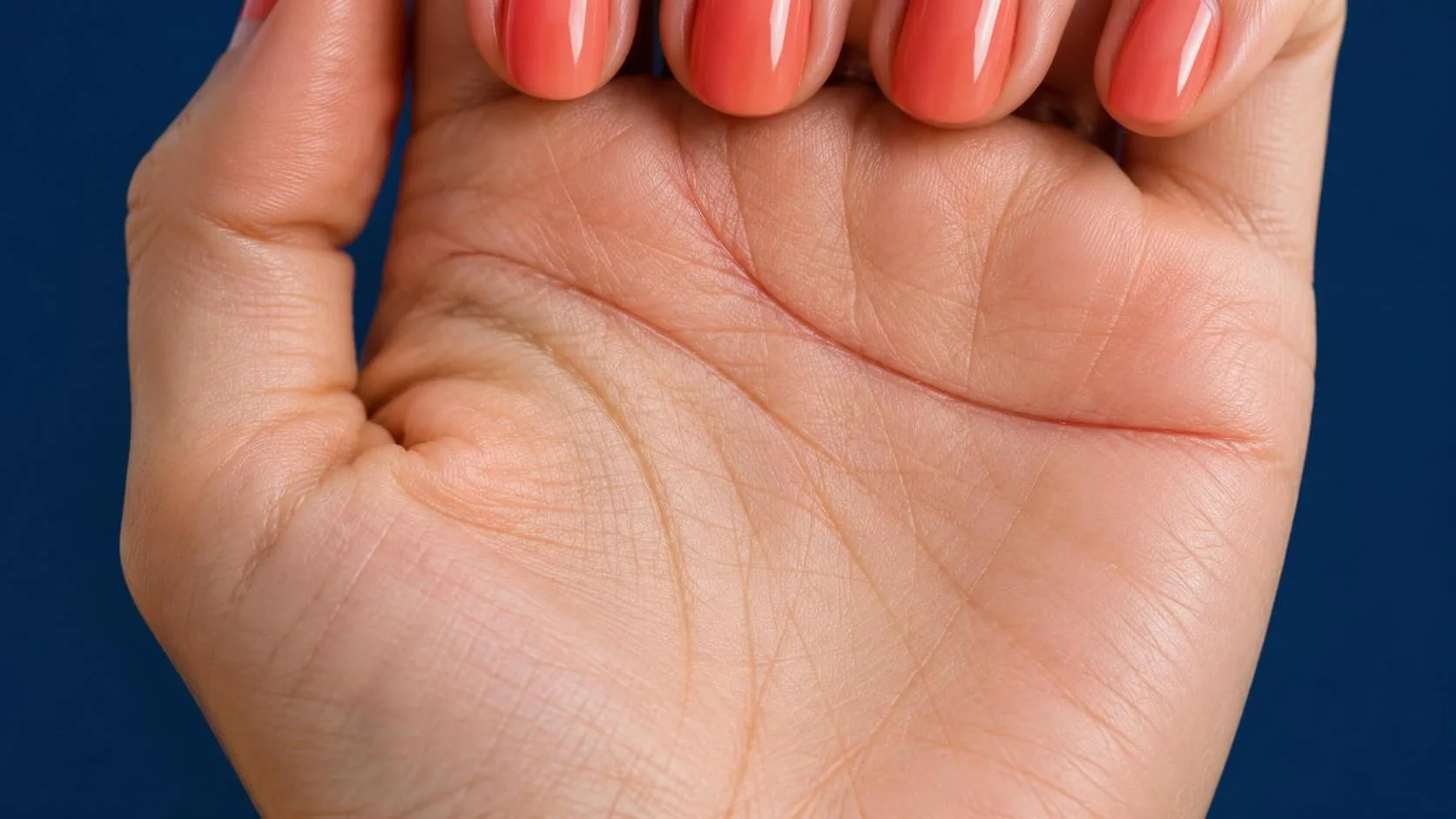
Look at the upper part of your palm, just below your fingers. The palm love line is usually the horizontal crease that starts near the little-finger edge and travels toward the index or middle finger. Palm readers more often call it the heart line, and traditionally associate it with emotional expression and relationships. It cannot tell you who you will marry or whether a relationship will last. Think of it as a conversation starter: does the way you show affection match the way you want to receive it?
Find the line before you interpret it
Open your hand comfortably, without stretching your fingers as wide as they will go. Look for the uppermost major crease running across the palm. It often begins beneath the little finger and moves inward, though its length, curve, and depth vary. Some hands have a single prominent crease across the palm rather than separate heart and head lines.
The head line generally sits below the heart line and is traditionally linked with thinking and decision-making. Smaller marks on the outside edge of the hand, beneath the little finger, are sometimes called relationship or union lines. Those are different from the main palm love line, even though people occasionally use similar names for both.
Good light helps. Turn your hand slightly rather than pressing on the skin, and take a clear photo if you want to compare both palms. A faint crease is still a crease; you do not need to hunt for tiny marks that are hard to see. If a photo will be shared publicly, remember that detailed palm images are personal information. Crop out identifying details and share only where you feel comfortable.
What its shape traditionally suggests
There is no universal palmistry rulebook. Different traditions and readers may describe the same feature differently, so start with what you can actually see and treat the interpretation as a prompt, not a personality test.
A curved line is often associated with an expressive or demonstrative approach to feelings. A straighter line is sometimes read as a more reserved or measured style. Neither means someone cares more than the other. A useful question is whether affection comes out most naturally through words, practical help, physical closeness, or something else entirely.
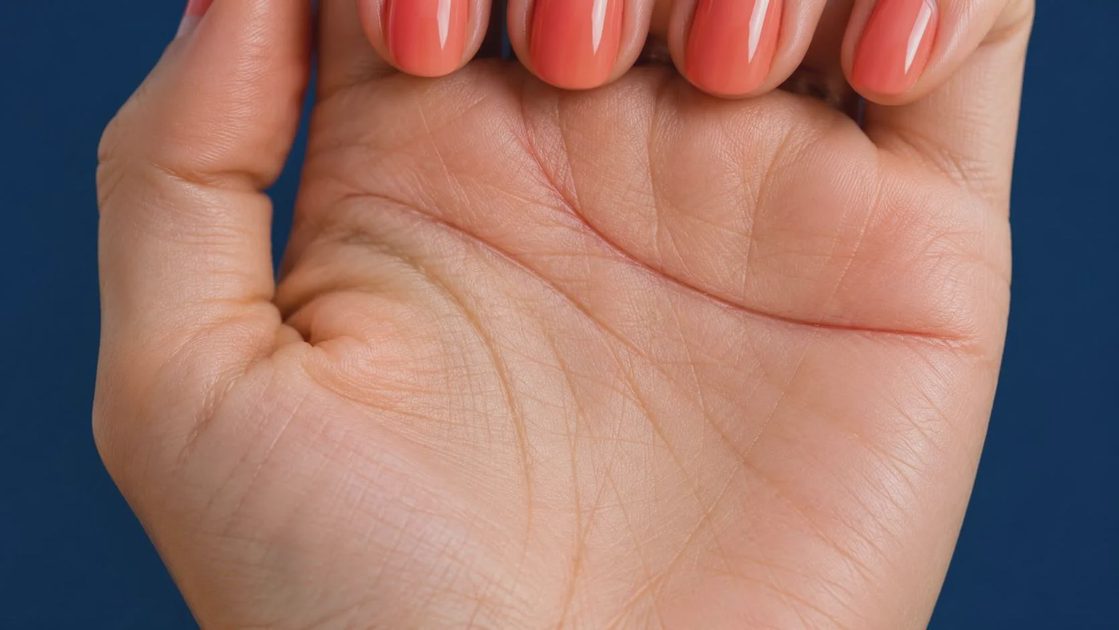
A long palm love line, extending well across the hand, is often interpreted as a tendency to give relationships considerable attention. A shorter one may be read as a preference for independence or a more contained way of expressing emotion. Short does not mean loveless, and long does not guarantee a lasting partnership. Palm creases vary naturally, and their length does not establish how capable someone is of intimacy.
Some readers also look at where the line ends. An ending under the index finger is traditionally linked with ideals about love; one under the middle finger may be associated with a more self-directed or practical approach. If it ends between the two, some readers describe a balance between those themes. These are symbolic associations, not findings about your character. If the ending is difficult to locate, it is perfectly fine to leave that part unread.
Breaks, branches, and faint marks
A break in the palm love line can look dramatic in a close-up, but it is not a prediction of a breakup. Traditionally, a reader might use it to ask about a change in emotional priorities or a transition in how someone relates to others. It can also simply be the way the crease appears. Lighting and skin texture can make an apparently continuous line look interrupted.
A fork near the end is often read as an ability to hold more than one perspective in relationships. Another reader might see it as a sign of competing needs. Rather than choosing whichever sounds more impressive, notice whether you recognize a real tension: perhaps you value closeness and also need plenty of time alone.
Fine upward or downward branches attract a lot of confident claims online. Interpretations vary, and very small marks can be difficult to distinguish from ordinary skin texture. I would focus on the overall path before assigning meaning to every little branch. A faint line is not evidence that your feelings are weak, either.
If your hand has one prominent transverse crease instead of separate major lines, some palmists call it a simian crease. Palmistry interpretations differ, and the crease alone cannot tell you about your emotional life or diagnose a health condition. You can skip the traditional reading entirely and still use the questions about connection and communication.
Which hand should you read?
Many palm readers compare both hands. One common approach treats the nondominant hand as a symbol of inherited tendencies or inner patterns, and the dominant hand as a symbol of habits expressed in daily life. Other readers reverse that emphasis or use a different system altogether. There is no scientifically established method that makes one hand the correct choice.
Start with your dominant hand if you want a simple first reading, then look at the other. Does the palm love line curve differently, end in another place, or appear more clearly? Describe those differences before interpreting them. You might use the comparison to reflect on a gap between what you feel and what you communicate, but you do not have to find a deep meaning in every difference.
If you are reading for someone else, ask permission before handling or photographing their hand. Offer observations gently, and let them say what resonates. A friend may enjoy the symbolism without wanting a public discussion of their relationships.
Turn the reading into a thoughtful gift
A palm reading can make a sweet gift story, but the recipient's actual preferences should lead. If they love handwritten notes, pair a simple card with a message about a specific moment when they made someone feel cared for. If they enjoy quiet time, a favorite tea or an invitation to an unhurried afternoon may fit better than a romantic symbol.
For someone who likes keepsakes, consider a small piece of art inspired by the curve of their own line, with their permission. You can make it yourself or ask an artist about a custom illustration. Agree on the price before ordering, and check whether the artist needs a detailed palm photo. A tracing or simplified sketch may be enough if the recipient would rather keep their image private.
The story matters more than the price: “This curve made me think about how openly you welcome people” is warmer than claiming a line proves something about them. What did you notice in your hand, and does that description fit the way you connect in real life?