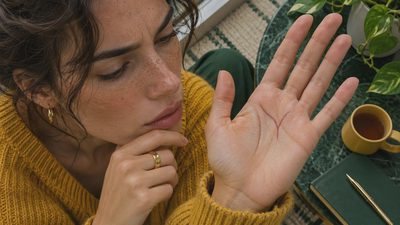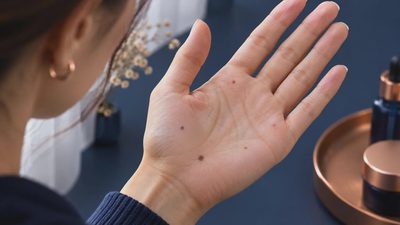

A forked fate line looks like a path that divides into two branches, often somewhere near the center or upper part of the palm. In palmistry, readers commonly associate that split with choices, overlapping commitments, or a change in direction. It is not proof that a career change is coming, and it cannot predict your future. Think of it as an invitation to ask: Where am I dividing my time or considering another path?
First, find the line and the fork
The fate line is traditionally described as a vertical line that travels up the palm toward the base of the middle finger. It may begin near the wrist, higher in the palm, or elsewhere, and it can be faint, interrupted, or absent. Plenty of hands do not have one obvious, continuous line.
To spot a forked fate line, look for one main line that separates into two visible branches. A branch can be short and subtle; it does not have to form a perfectly symmetrical Y. Rotate your hand in soft light and relax your fingers rather than stretching the skin tight. Then follow each branch with your eye to see whether it really joins the same line.
A crossing crease is different from a fork: it passes through the line rather than separating from it. Two nearby vertical lines may also be separate features rather than branches of one line. If you cannot tell, that is a perfectly reasonable observation, not a failed reading.
Palm lines are normal skin creases, and palmistry is a symbolic tradition rather than a scientifically validated way to assess personality or forecast events. Readers also use different traditions, so there is no single authoritative interpretation of every marking.

What a forked fate line traditionally suggests
The fate line is often associated with work, direction, responsibility, and the way a person navigates the wider world. A fork adds the image of a path with more than one possible direction. That might resonate with someone balancing a job and a creative practice, weighing a move, or noticing that family obligations shape their working life.
Another reader might see the same split as a sign of flexibility rather than a decision between two options. You do not have to choose the interpretation that sounds most dramatic. Ask whether the image of a branch brings anything useful to mind; if it does not, leave it there.
The location of a forked fate line can also influence a traditional reading. A split near the top of the line is sometimes read as a later shift in priorities, while one lower down may prompt a conversation about an earlier or more foundational choice. Exact age estimates vary between readers and are not reliable predictions, so I would skip any chart that claims to pinpoint the year your life will change.
Depth is another detail to notice. One strong branch and one faint branch might invite a discussion about a well-established commitment alongside a developing interest. Two similarly visible branches might suggest competing priorities to one reader and complementary roles to another. Neither appearance guarantees success or failure.
Notice where the branches go
Some palmists give added meaning to the area a branch approaches. The raised pads beneath the fingers are called mounts, and traditional readings associate each one with a different theme. These associations are interpretive, not measurements of your abilities.
A branch pointing toward the area below the index finger, often called the mount of Jupiter, may be read in connection with ambition or leadership. One leaning toward the area below the ring finger, called the mount of Apollo or Sun, may prompt thoughts about creativity or recognition. A branch continuing toward the middle finger may be interpreted through themes of responsibility and structure.

These directions are not always clear. A forked fate line may end in the middle of the palm, curve between mounts, or fade before it reaches a distinct area. Describe what you can actually see before assigning it a destination. And if a branch points downward or sideways, resist the urge to label it bad news: a line's direction is not evidence of an impending setback.
Which hand should you read?
A common approach is to compare both hands. Some readers treat the dominant hand as a reflection of present-day choices and the nondominant hand as a picture of underlying tendencies or earlier influences. Other traditions reverse or modify those associations. Neither approach has been scientifically established, so use whichever helps you ask better questions without treating either hand as a verdict.
If the split appears on only one hand, note the difference rather than trying to explain it away. You might ask whether there is a choice you are actively managing now, or whether the image of two paths feels more like an old story. It is also fine if neither idea fits.
For a clearer look, photograph each open palm in even light, with the wrist and fingers visible. Avoid heavy filters or sharpening, which can make small creases look more prominent. If you share a photo in a community, crop out identifying details and consider whether you are comfortable posting it publicly.
Turn the reading into a useful conversation
A forked fate line can be a gentle conversation starter when you keep the focus on the person rather than the prediction. Try asking, “Are there two parts of your life asking for attention?” or “Is there a direction you have been curious to explore?” Give the person room to say no. A good reading should leave them feeling heard, not boxed in.
If you want to pair the conversation with a gift, begin with their actual habits and your budget. For someone who likes writing, a simple notebook could hold ideas for the two projects they keep mentioning. For a person who prefers time together, an invitation to a walk and a shared coffee can be more meaningful than a symbolic object. You can include a short note about the conversation, without suggesting that their palm requires them to make a particular choice.
Look once more at the branches: what do you see, and does either path remind you of something in your life right now?