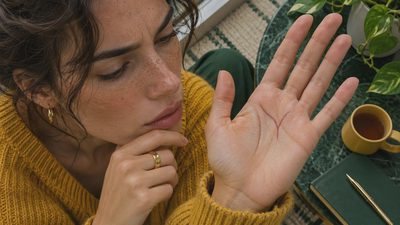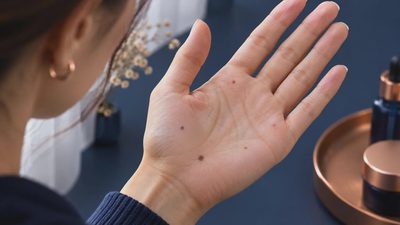
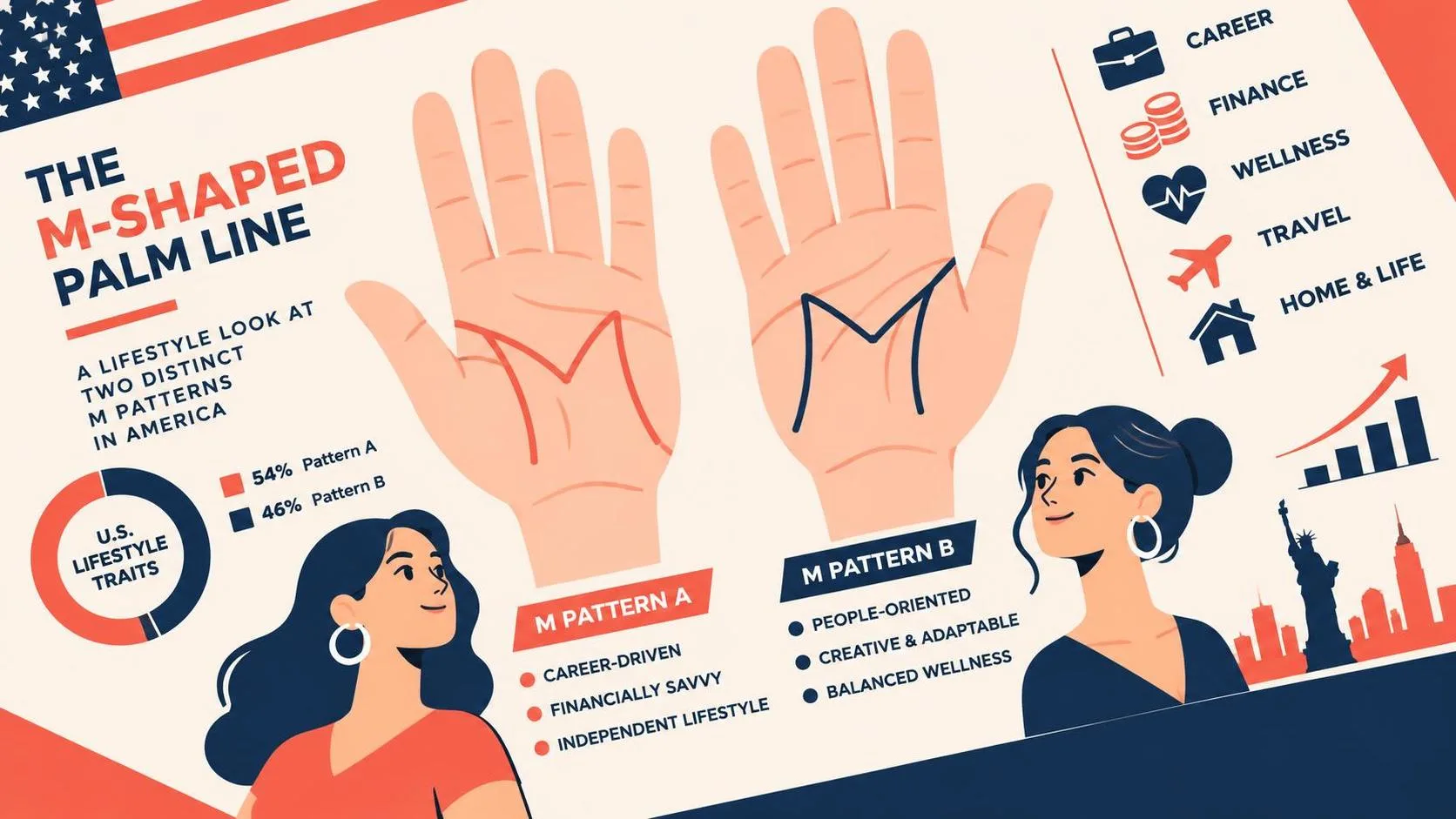
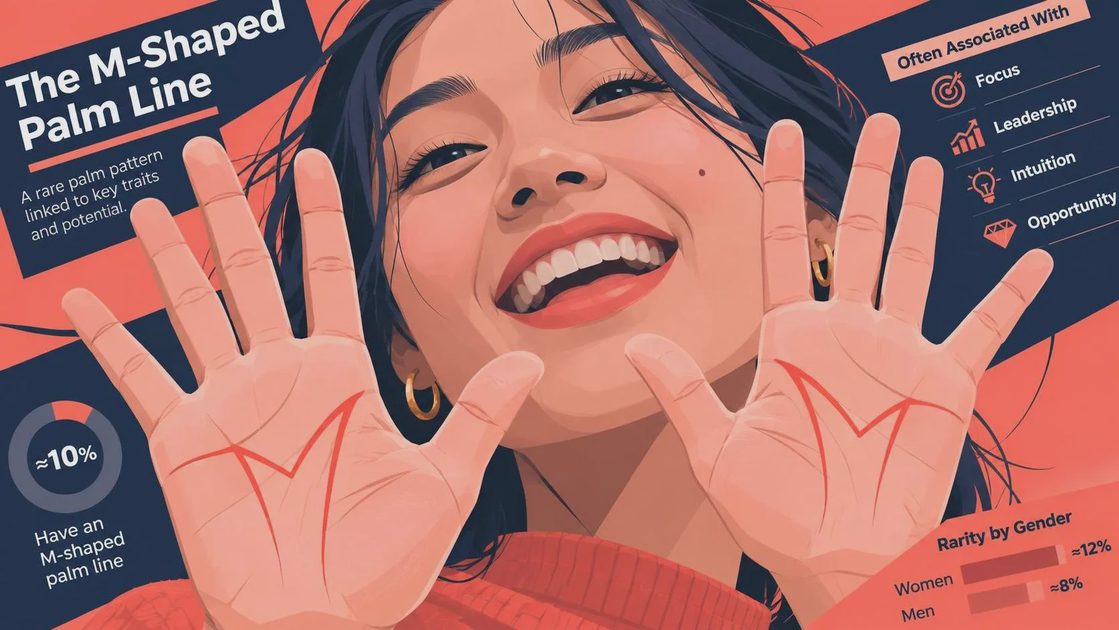
If you have noticed an m on both palms of female hands, you are probably seeing several ordinary palm creases meet or cross in a shape that resembles the letter. In palmistry, that pattern is often associated with intuition, determination, or a talent for noticing what others miss. Those are traditional interpretations, not proven personality traits or predictions. Look at your own hands with curiosity: does the shape stand out clearly, or do you have to trace a few possible routes to see it?
How to find the M shape
Open one hand in comfortable, even light and let the fingers relax. You are looking for a loose letter M across the central palm, not a perfectly printed character. Depending on the hand and the reader, the shape may appear where these familiar lines meet or run close together:
The heart line generally runs across the upper palm, beneath the fingers. Palm readers associate it with emotional expression and relationships.
The head line generally crosses the middle of the palm. Traditionally, it is read as a reflection of thinking style or approach to decisions.
The life line curves around the base of the thumb. Despite its name, its length does not tell you how long you will live.
The fate line, when visible, tends to run upward through the center of the palm. Some readers connect it with work, direction, or a sense of purpose. Not everyone has an obvious fate line, and an M can be traced differently from one hand to another.
A small crease may complete the shape, or a gap may make the letter less obvious. There is no universally agreed-upon test for whether an M is real. If two readers draw the letter differently, that is a difference in interpretation, not a problem with your hands.
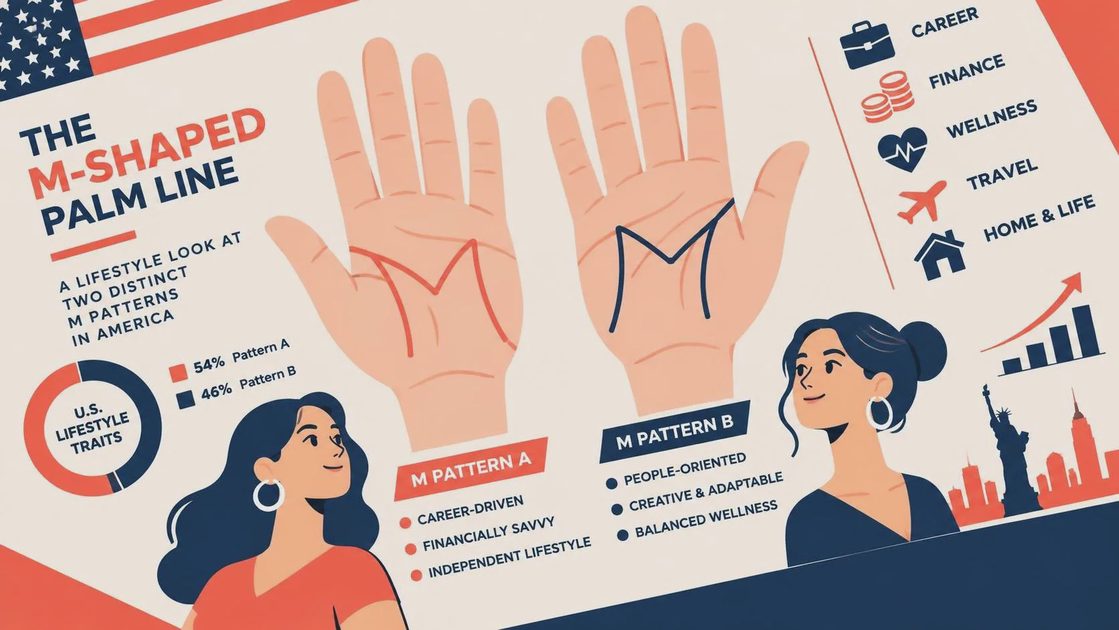
What does an m on both palms of female hands traditionally mean?
Some palmists take the M as a sign of intuition: an ability to pick up on subtle details or trust an internal sense of what feels right. Others emphasize persistence, practical judgment, or leadership. A reader who sees the pattern on both hands might describe those themes as especially consistent in a person's life.
That last step is interpretation, not evidence that the marking makes a trait stronger. Palm lines are normal skin creases, and there is no scientific basis for using an M to establish someone's character, predict wealth, or guarantee success. Claims that the shape proves a person is unusually gifted or destined for a particular relationship are more confident than the evidence allows.
I find the symbolism most useful as a question rather than a label. If intuition resonates, ask yourself what information you notice before making a decision. If persistence fits better, think about where you have chosen to keep going and where you would rather give yourself permission to stop.
Does the meaning change for women?
Some palmistry traditions assign different meanings or different reading priorities to hands according to gender. Those customs vary, and there is no single rule that all palm readers follow. You may see a claim that one hand matters more for women and the opposite hand matters more for men; treat that as one tradition's approach, not a fact about female hands.
A more flexible starting point is to compare your dominant hand with your non-dominant hand. Some readers associate the dominant hand with the way a person acts in daily life and the other with tendencies or potential. Others reverse the emphasis or read both hands together. None of these systems can establish what you were born to do.
If you are reading for someone else, ask which framework feels comfortable to them instead of making assumptions about gender, relationships, or family roles. The person attached to the palm gets the final word about what feels meaningful.
Comparing the shapes on your two hands
Place your palms side by side and notice where each apparent M begins and ends. Is one shape made mostly by deep creases while the other relies on finer ones? Does a vertical line cross the middle on both hands, or only one? Try tracing each route lightly with a fingertip; avoid pressing hard enough to create temporary marks that look like extra lines.
Different-looking hands do not mean that one side is good and the other is bad. Creases and smaller lines naturally vary, and lighting, dry skin, and the angle of your hand can make a pattern easier or harder to see. A clear photo taken in indirect light can help you compare the hands without trying to remember every detail.
If you share photos in a community, decide how much you are comfortable revealing. Crop out identifying details in the background, and remember that palm images contain personal biometric information. You can also describe the lines without posting a picture.
A gift inspired by the reading
An M-shaped crease can be a sweet starting point for a gift, but the recipient's actual habits should lead. For someone who likes to write, a small notebook with a note about a decision they handled thoughtfully can make the intuition theme personal. For a person who enjoys quiet evenings, a favorite tea and a handwritten invitation to catch up may say more than a palm-shaped trinket.
If you are working with a small budget, write the story on a card: “Your palm reminded me of how carefully you notice things.” You could add a simple drawing of the lines rather than buying anything. The point is not to tell someone who they are; it is to share a quality you appreciate and leave room for them to respond.
When you look at your two palms, which interpretation feels closest to your real life—and which one would you leave out of your own story?