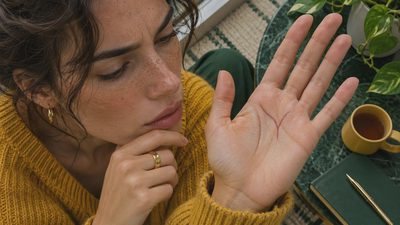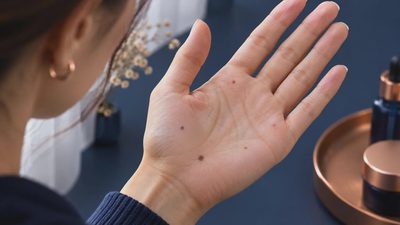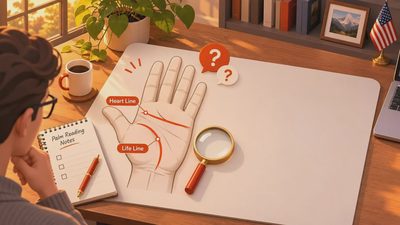
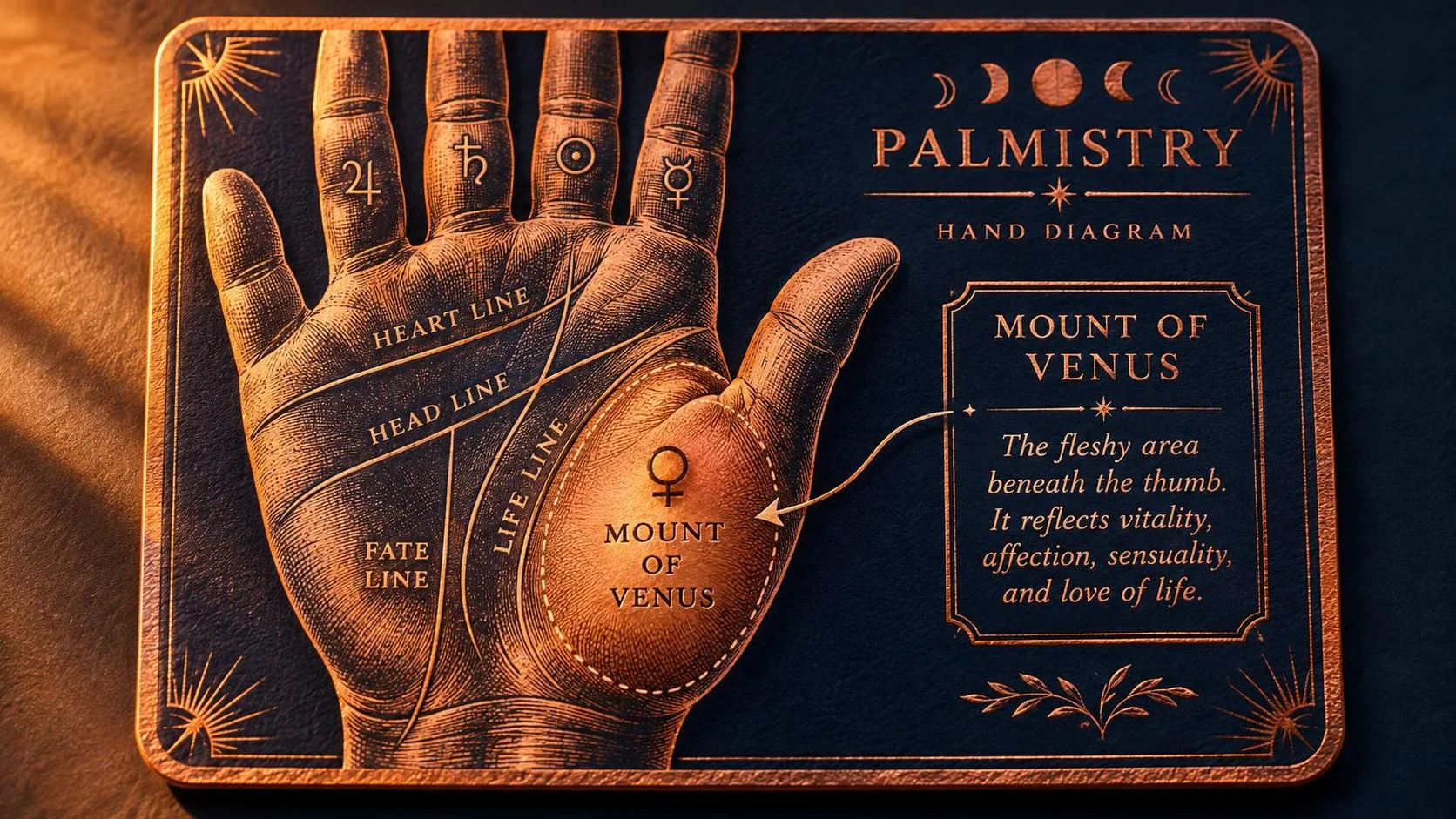
If you are exploring mount of venus palmistry, start with the soft, raised area at the base of the thumb rather than with a dramatic prediction. In traditional palmistry, this part of the hand is associated with affection, vitality, pleasure, warmth, and the way someone connects with everyday life. It is not a medical test or a fixed script for your future. Think of it as a visual prompt: what does this person seem to value, and how does that show up in their relationships?
The first thing to notice is the shape and texture. Compare the mount with the rest of the palm, look at both hands, and observe whether the skin feels firm, springy, flat, or especially soft. Lighting matters, too. A hand photographed after a long day can look different from one that is relaxed and warm.
Where the Mount of Venus Is Located
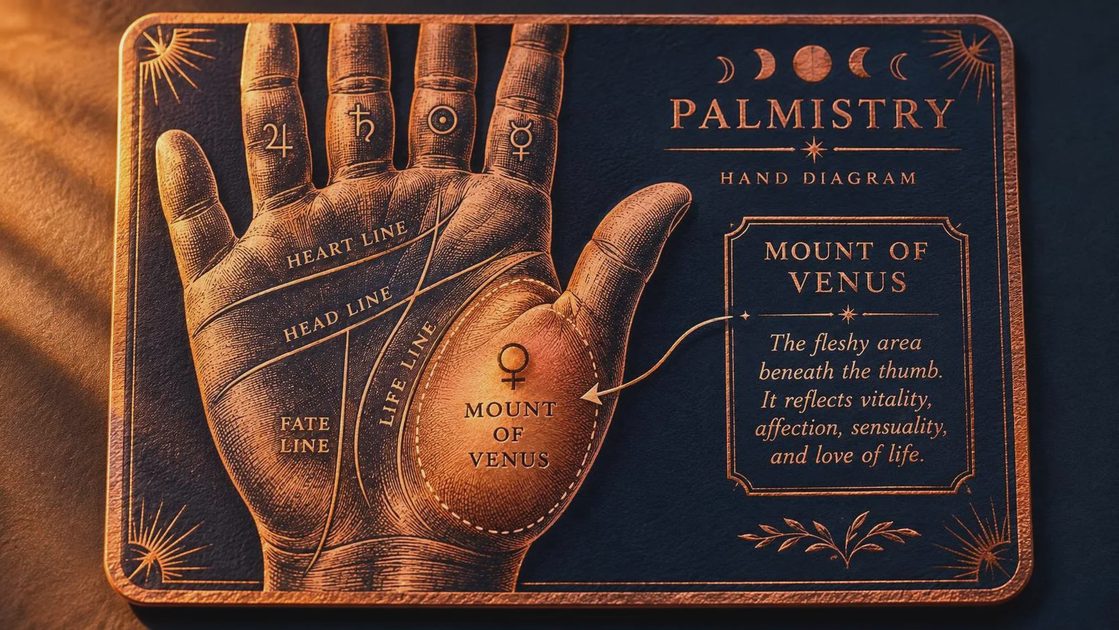
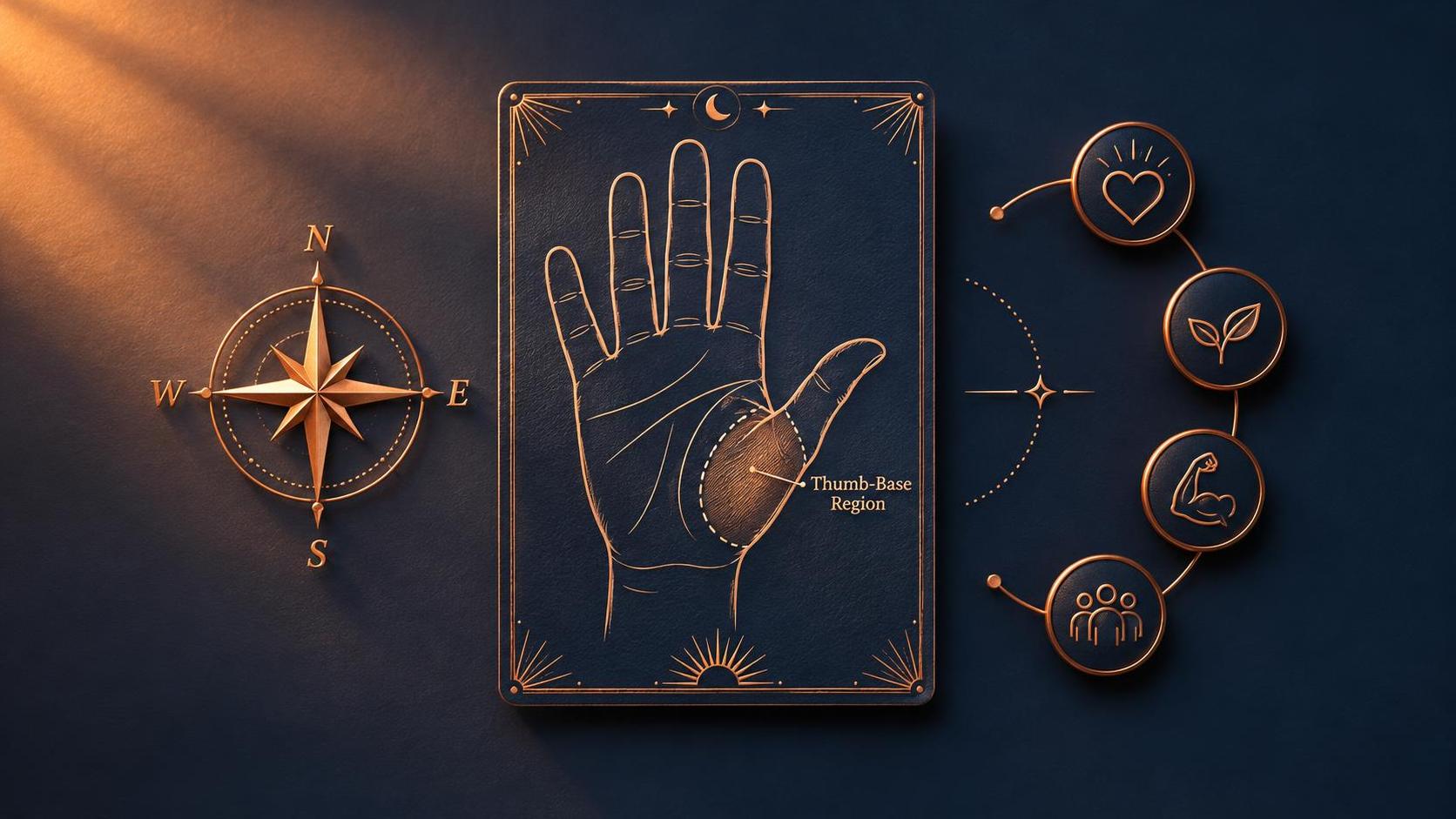
In mount of venus palmistry, the Mount of Venus is the padded section inside the curve of the life line, directly below the thumb. It is usually easy to find because it feels fuller than the nearby palm. The life line often arcs around it, although the line itself does not define the mount. A large area can suggest that this region is prominent in a person’s hand, while a flatter area may simply reflect hand shape, age, hydration, muscle, or the way the hand is held.
For a useful home observation, place the palm on a table without pressing down. Use a side light or take two photographs, one with the fingers relaxed and one with the thumb gently open. Compare the left and right hands. Traditional readers often consider the non-dominant hand a picture of inherited tendencies and the dominant hand a picture of habits developed over time, but readers disagree about this framework. Treat it as one lens, not a rulebook.
What a Full or Firm Mount May Suggest
A noticeably full Mount of Venus is traditionally linked with enthusiasm, physical energy, generosity, and an enjoyment of comfort. Someone with this feature may be described as affectionate or expressive, especially when the hand also looks warm and flexible. In ordinary language, that could mean a person who remembers birthdays, reaches for a friend’s hand, cooks for visitors, or turns a quiet evening into a shared ritual.
A firm mount can add a sense of steadiness to that interpretation. It may point to someone who enjoys pleasure without being easily swept away by it. A very soft mount, on the other hand, is sometimes read as sensitivity and receptivity. None of these observations prove a personality trait. Ask what fits the person’s actual behavior. Does the hand match someone who gives time freely, or is the symbolism describing an aspiration they are still growing into?
When the Mount Looks Flat or Less Prominent
A less pronounced Mount of Venus does not mean a person lacks love, attraction, or emotional depth. In mount of venus palmistry, a flatter area is sometimes interpreted as restraint, privacy, practicality, or a preference for showing care through actions instead of grand displays. A person may be devoted while still needing plenty of personal space. They might repair a loose cabinet, organize a useful surprise, or quietly check that everyone got home safely.
Body composition, temperature, age, and camera angle can change what you see. That is why a single snapshot should not become a verdict. Compare the area with the person’s other palm and with photographs taken at different times. If your interpretation feels uncomfortably negative, soften it and return to observable life. “This person may be selective about affection” is more useful than “this person is cold.”
Lines, Grilles, and Color: Read the Whole Picture
Readers practicing mount of venus palmistry often examine markings over the mount, but this is where overconfident interpretations become especially tempting. Fine crossing lines may traditionally be associated with emotional sensitivity, many attachments, or a busy social life. A clean, relatively unmarked area may be read as uncomplicated energy or directness. Redness, dryness, creases, or uneven color can result from ordinary skin conditions, friction, temperature, or circulation and should not be treated as mystical evidence or a diagnosis.
The surrounding lines matter more than one mark in isolation. Look at the life line’s arc, the thumb’s flexibility, and the overall balance of the palm. A strong-looking thumb paired with a full mount might be described as affection guided by firm preferences. A flexible thumb with a soft mount could suggest generosity and adaptability. These are traditional story prompts, not guarantees. The most respectful reading leaves room for the person to say, “That fits,” or “Actually, I am different.”
Turn a Palm Reading Into a Thoughtful Gift
The best gift inspired by mount of venus palmistry does not have to announce palmistry to everyone in the room. Begin with the recipient’s habits. Someone who loves cozy rituals might appreciate a hand-thrown mug, a soft throw, or a small candle in a familiar scent. A practical, affectionate person may prefer a leather key organizer, a personalized recipe card set, or a framed photo from an ordinary day that mattered.
For a partner, a gift connected with shared touch and comfort can be meaningful without becoming overly intimate: matching coffee cups, a weekend breakfast kit, or a simple bracelet chosen for its color and story. For a parent or close friend, consider something that reflects how they show care, such as a garden tool, a favorite tea, or a handwritten note paired with a useful object. A handmade item from Etsy can work well when the design is restrained and the seller explains materials clearly. The symbolism should support the relationship, not replace it.
A Simple Reading Method for Beginners
If you want to practice mount of venus palmistry, take five quiet minutes. First, describe only what you see: location, size, firmness, skin texture, and any obvious lines. Second, write two possible interpretations instead of choosing the most dramatic one. For example, a full mount might suggest warmth and sociability, or it might simply be a naturally padded palm. Third, test the reading against the person’s life. What do they do when someone needs help? How do they rest? Do they seek closeness, or do they show love through reliable routines?
Finally, ask permission before reading someone else’s hand and avoid predictions about death, illness, betrayal, or unavoidable misfortune. Palmistry is most useful as a reflective conversation. If a feature makes someone anxious, say so plainly: hands change, traditions differ, and no mount can sentence a person to an outcome.
The Question to Carry Forward
A thoughtful approach to mount of venus palmistry ends with curiosity. Notice the physical feature, learn the traditional associations, and then compare them with the person in front of you. Perhaps the mount reminds you that they love hosting friends; perhaps it highlights a need for more rest and comfort; perhaps it simply gives you a new language for appreciation.
If you are choosing a gift, let the real story lead. Ask what they use every day, what memory you share, and what small pleasure they rarely buy for themselves. Then choose something that says, “I notice how you care,” rather than something that claims to predict who they are.