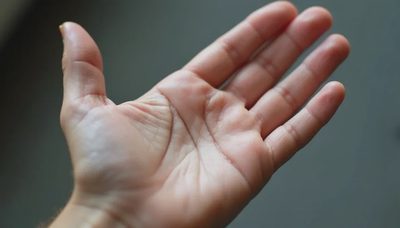
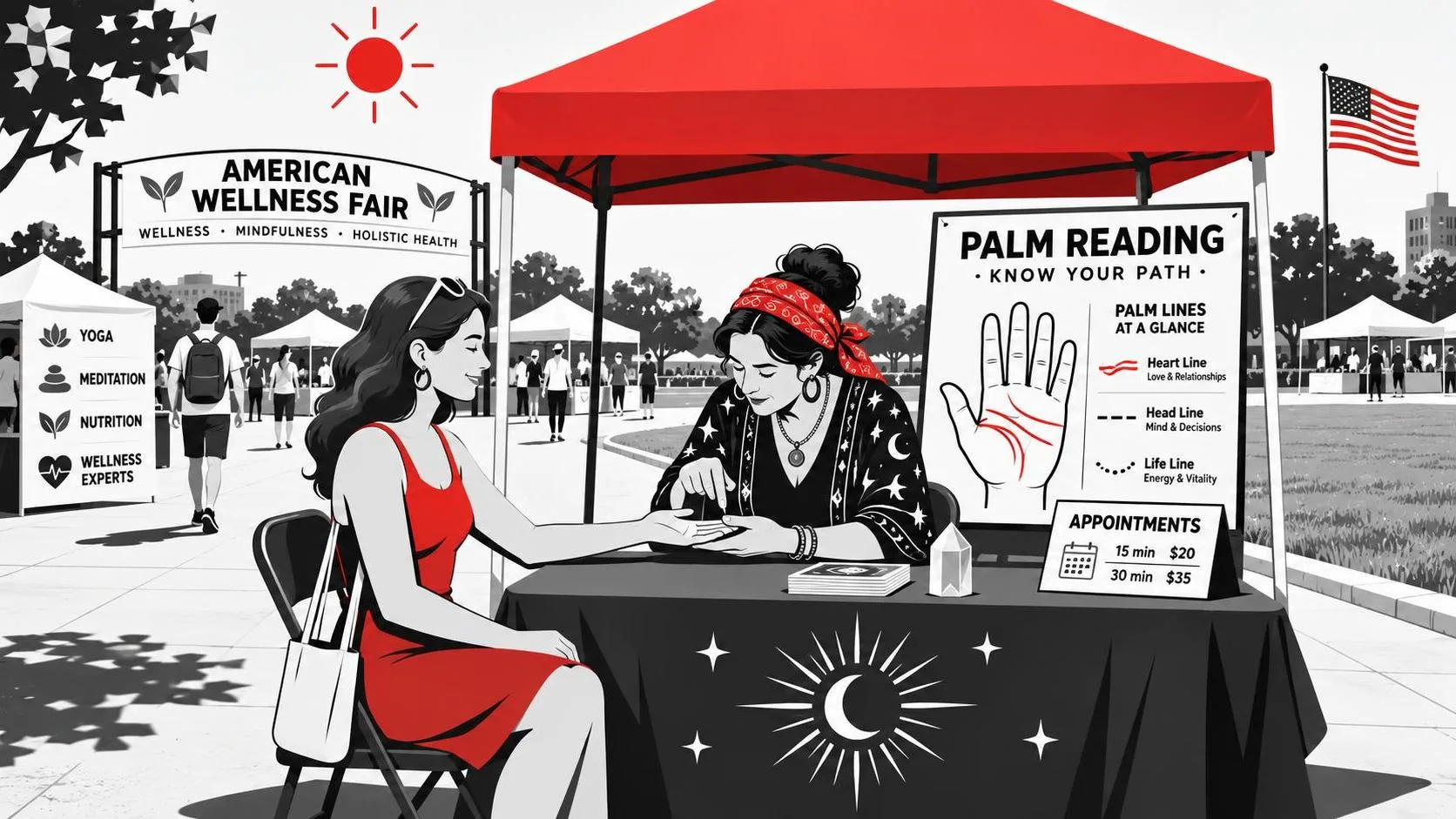
Open your left hand and look for the crease curving around the base of your thumb. That’s the life line, and its length is not a countdown. If you’re exploring left hand palm reading for female readers, start by knowing that some traditions associate a woman’s left hand with inherited tendencies, while others use different rules. There’s no single authoritative method, and palmistry is a reflective practice, not a scientifically supported way to predict personality or the future.
Which hand should a woman read?
You may hear that women should read the right hand and men the left, or the reverse. Those are traditional rules, not universal ones. Another common approach is to compare the dominant hand, often associated with how someone acts in the world, with the non-dominant hand, associated with underlying tendencies or potential.
That means your left hand might be your non-dominant hand if you write with your right. If you’re left-handed, the roles may switch in a dominant-hand reading. Neither approach is more scientifically valid; choose the framework that makes the conversation useful rather than treating gender as a rule you have to obey.
I like to begin with the left hand on its own, then bring in the right for comparison. Notice what is actually visible before attaching meaning: Is a line long or short? Deep or faint? Does it appear to branch? Hands crease differently, lighting changes what you see, and not every palm has a neatly labeled set of lines.
Left hand palm reading for female readers: Find the main lines
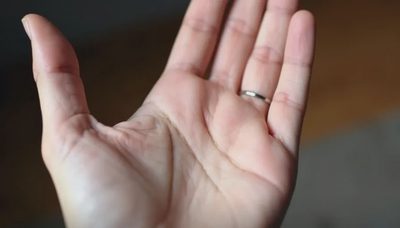
Rest your hand comfortably in good light, with the palm facing up and fingers gently extended. You don’t need to pull the skin taut. The three main lines are usually easier to find by their position than by their depth.
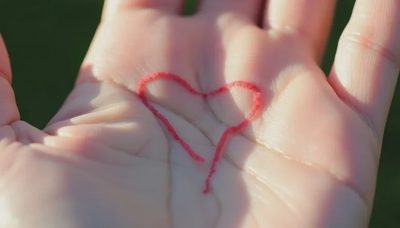
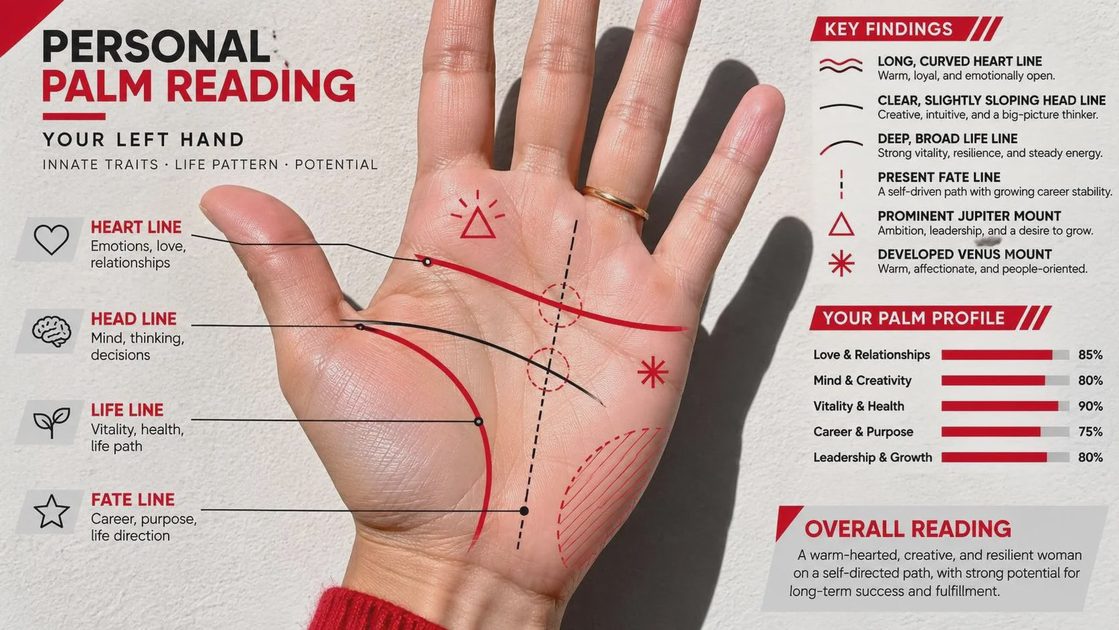
The heart line generally runs across the upper palm, below the fingers. Palm readers often connect it with emotional expression and relationships. A curved line may be interpreted as open expression; a straighter one may suggest a more reserved style. Those are symbolic readings, not personality tests. A faint line may simply be hard to see in your lighting.
The head line generally crosses the middle of the palm, beginning near the thumb side. Traditionally, a straighter line is associated with practical or focused thinking, while a more sloping line can be linked with imagination. A line that seems to change direction might invite a conversation about different ways you approach problems. It doesn’t establish intelligence or ability.
The life line usually arcs from the area between the thumb and index finger around the fleshy base of the thumb. Readers often associate it with vitality, habits, or a person’s approach to change. A short, faint, or interrupted life line does not predict a short life, illness, or disaster. If the crease is difficult to follow, try viewing your hand from a different angle rather than filling the gap with a frightening story.
A fourth crease, often called the fate line, may run upward through the center of the palm. Some readers connect it with direction, work, or outside influences. Not everyone has an obvious one, and its absence says nothing certain about career or purpose.
How to compare both palms without overreading them
Place your hands side by side and look at one feature at a time. Perhaps your heart line looks more curved on one hand, or the head line is easier to trace on the other. Describe that difference first: “The line looks deeper on my left.” Only then consider what it might mean within the tradition you’ve chosen.
In a dominant-hand approach, someone might interpret a difference as a contrast between an inner preference and an outward habit. Another reader may see it as a reminder that people behave differently in different settings. It’s equally reasonable to leave the difference uninterpreted: creases and visibility vary, and a palm cannot verify either story.
If you’re sharing a photo for discussion, use soft, even light and include the whole palm from the wrist crease to the fingertips. A relaxed hand and a second photo of the other palm give readers more context. Avoid posting identifying details in the background, and check a community’s privacy rules before uploading. You can always describe a line instead.
What about mounts, breaks, and tiny lines?
Mounts are the padded areas beneath the fingers and around the thumb. In palmistry, the area at the base of the thumb is often called the mount of Venus and associated with affection or enjoyment. Its prominence varies with hand shape and the position of the thumb; it isn’t a measure of how loving someone is.
Small branches, crossings, and breaks can be interesting prompts, but they’re especially easy to interpret inconsistently. A branch off the head line might be read as curiosity by one person and a shift in attention by another. Dry skin, shallow creases, and shadows can also make a line look broken. When a detail is ambiguous, saying “I’m not sure” is a perfectly good reading.
Skip anyone who uses a crease to sell a cure, predict a tragedy, or pressure you into paying for protection. Palmistry can be a thoughtful conversation starter; it is not a substitute for medical, financial, or mental health advice.
Turn a reading into a personal gift
If you’re reading for someone else, ask permission and listen to their own interpretation. Then let their everyday life lead the gift choice. For a person who enjoys writing, a modest notebook with a note about the idea they shared can feel more personal than an expensive palm-themed object. For someone who loves quiet evenings, a favorite tea and a handwritten invitation to catch up might fit better.
The symbolism is the story you attach, not proof about the recipient. You might say, “Our conversation about your heart line reminded me how much I value our long talks.” Keep the cost comfortable, and don’t assume a palm reveals what anyone wants.
Look again at the feature that first caught your eye. What do you notice, and does any traditional interpretation connect with your real life?