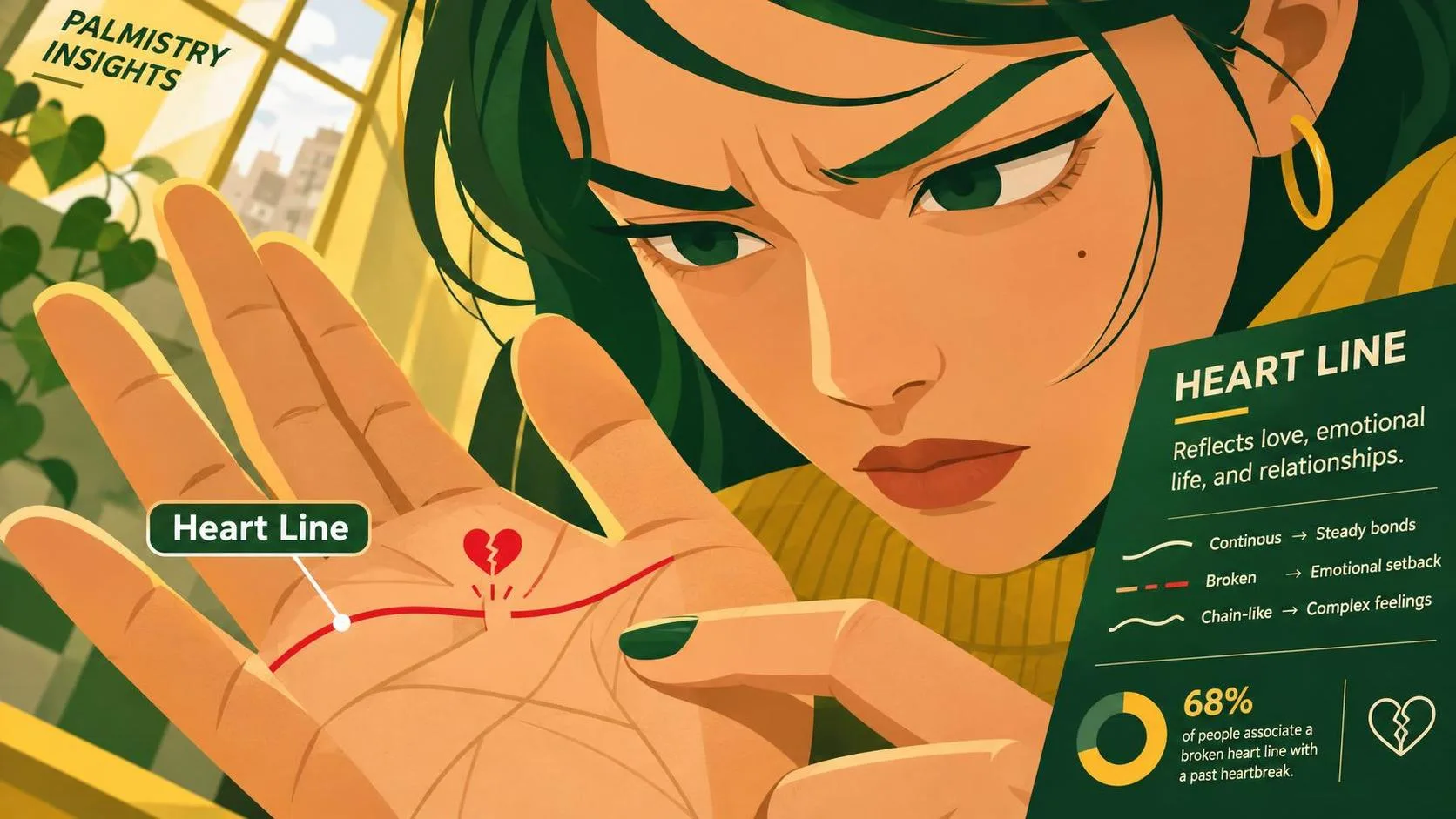
When someone notices a split or interruption beneath the fingers, the first question is usually emotional: does this mark mean heartbreak? In broken heart line palmistry, readers traditionally examine the whole line, not one gap in isolation. The heart line is the upper major crease running across the palm, beginning near the little-finger side and moving toward the index finger or the space between the index and middle fingers. Palmistry is a reflective tradition, not a medical test or a fixed forecast, so use the pattern as a prompt for self-understanding rather than a sentence about your love life.
First, find the heart line correctly
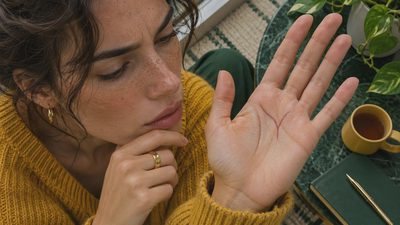
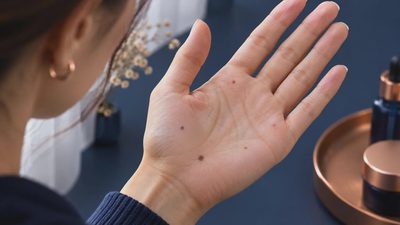
Hold your palm open and look for the highest long crease that travels horizontally below the fingers. It is often easier to see in the dominant hand, but comparing both hands can add useful context. Some people have a clear, deep line; others have a lighter crease interrupted by small vertical marks, skin texture, or several overlapping folds.
Before interpreting anything, take a well-lit photo with your hand relaxed. Do not stretch the fingers wide, because that can pull the skin and make a natural crease look broken. A phone camera, indirect daylight, and a plain background usually show more than a dramatic close-up under a harsh lamp. Notice whether the gap is a true interruption, a faint section, a branch, or simply a crease hidden by dry skin.
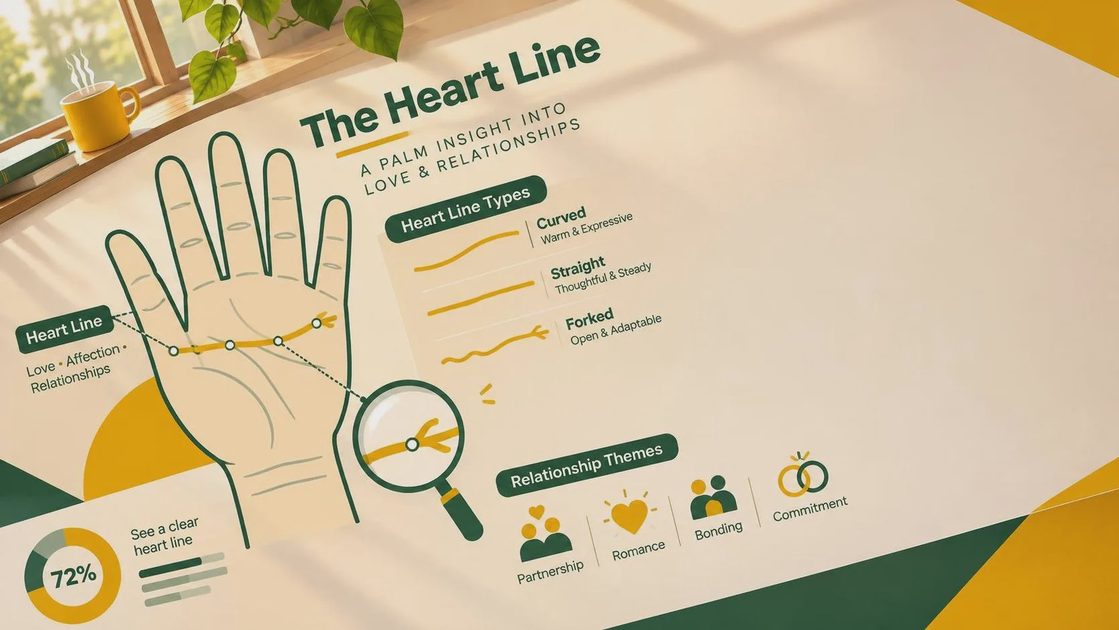
Traditional readers also compare length, depth, direction, and the line's relationship to the mounts beneath the fingers. A heart line ending under the index finger is often read differently from one ending under the middle finger. Those details create a conversation about emotional style; they do not prove that a person is loyal, difficult, destined for one partner, or headed toward loss.
What a break can traditionally suggest
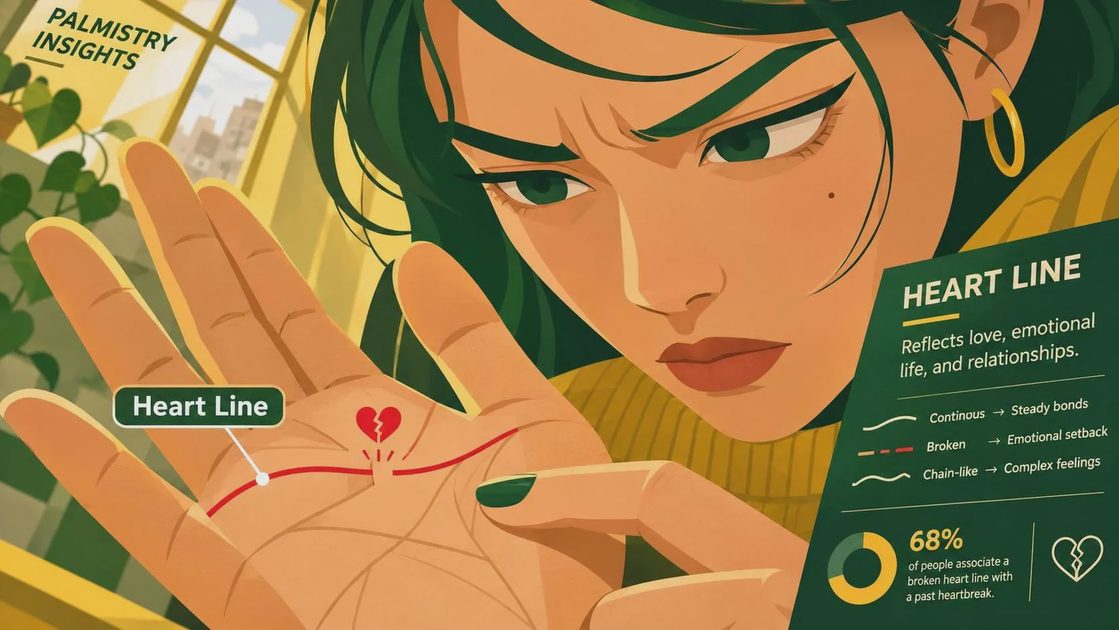
In broken heart line palmistry, a visible break is commonly associated with a change in emotional priorities, a period of guardedness, or a strong shift in how someone approaches intimacy. That shift could follow a breakup, a move, a demanding work season, family responsibility, or simply growing older. It does not automatically represent a tragic event.
The size and appearance of the interruption matter. A small gap with the line continuing at a similar depth may be read as a temporary reset. A larger gap, especially when the two sections point in different directions, is sometimes interpreted as a marked change in emotional expression. Some readers see the first segment as an earlier chapter and the next segment as a later, more self-directed chapter.
There is also a practical explanation: palms have many creases, and lines can look different depending on hydration, lighting, age, and how the hand is held. If a supposed break appears only in one photograph, take another image before building a story around it. Here is what readers usually notice; now ask what period of real life, if any, makes that interpretation feel familiar.
Breaks, islands, chains, and branches
A break is not the only feature people describe. An island looks like a small oval or loop within the heart line. Traditional palmistry often connects islands with emotional complexity, uncertainty, or a period when feelings are divided. A chain-like line, made of many tiny linked marks, may be associated with sensitivity or fluctuating moods. These are symbolic readings, not diagnoses of anxiety, depression, or relationship health.
Branches can change the tone of a reading. An upward branch toward the fingers is often considered an optimistic sign, suggesting initiative or an ability to express affection. A downward branch may be read as emotional fatigue, disappointment, or a need to conserve energy. Again, context matters. A single downward stroke near the end of a line should not outweigh the person's actual relationships, communication habits, and current circumstances.
For a beginner, the best method is to describe before interpreting: “The line is deep until this point, then lighter, with one upward branch.” That observation is more useful than jumping directly to “I will always struggle in love.” In broken heart line palmistry, careful description keeps curiosity from turning into fear.
Compare both palms without forcing a prediction
Many palmistry traditions compare the dominant and non-dominant hands. One hand may be discussed as inherited tendencies or early conditioning, while the other is treated as lived choices and current expression. Different teachers reverse or modify that framework, so there is no single universal rule. The comparison is still useful when it helps you notice change over time.
If one palm shows a clear break and the other shows a continuous line, a reader might frame that contrast as a difference between inner sensitivity and outward behavior. Another reader may simply say the creases developed differently. Both interpretations can coexist without anyone needing to win an argument. The most grounded question is whether your communication, boundaries, or expectations have changed recently.
Avoid using a palm to make decisions about leaving a partner, confronting a friend, or rejecting someone new. A conversation, repeated behavior, and personal safety provide stronger evidence than a line. Palmistry works best as a journaling prompt: What changed? What do I want now? Which boundary would make affection feel more secure?
A simple reading you can try at home
Start with a clean photograph of each palm and mark the heart line's beginning, ending, depth, and direction. Next, describe any gap in neutral language. Write down whether it appears on one hand or both, whether the sections align, and whether branches point upward or downward. Then add real-life context without trying to make every event fit: perhaps you became more private after college, learned to communicate directly after a difficult friendship, or now prefer slower relationships.
Share the image with a trusted friend and ask what they observe before telling them your interpretation. This prevents suggestion from doing all the work. If you post in a palmistry community, crop out identifying details and remember that strangers may use different traditions. A respectful disagreement can still be useful when everyone separates observation from belief.
This is also where broken heart line palmistry becomes personal rather than predictive. The line can invite a question about how you protect your tenderness while remaining open. That question has value even if you view palmistry as creative symbolism instead of divination.
Pair the reading with a meaningful gift
A palm-inspired gift does not need to announce that someone has suffered heartbreak. Choose something connected to their habits and the story you share. For a friend who loves journaling, a $15 to $30 pocket notebook with a handwritten reflection can turn the reading into an evening ritual. Someone who prefers jewelry might enjoy a simple engraved bracelet, a palm-shaped charm, or a birthstone piece in the $25 to $75 range.
For a partner, skip overly dramatic “broken heart” imagery unless that language genuinely fits your relationship. A framed palm photo, a small keepsake box, or a custom card describing one quality you admire can feel more intimate. The gift should say, “I notice how you have grown,” not, “Your palm proves something about you.”
The best thread to follow is the recipient's real personality. If they are skeptical, offer a funny palm-reading card and coffee rather than an expensive mystical object. If they love symbolism, pair a thoughtful reading with a handmade item and explain why you chose it. Every reading ends with a question, and every gift ends with a story: what part of the person did you hope to honor?
The grounded takeaway
Broken heart line palmistry traditionally treats an interruption as a symbol of change, guardedness, or emotional reorganization, not an unavoidable promise of heartbreak. Check the line's shape, compare both hands, photograph it in good light, and keep the person's lived experience at the center. Your palm can be an interesting mirror, but it is not the author of your relationships. What does the line make you curious about in the life you are actually building?